
Published · Updated
Service Case Study Page: What to Include and How to Build One

A service case study page is a single page that tells one job from start to finish: who the customer was, what was wrong, what you did and what changed afterward. The pages that win work for local businesses are specific. They name the neighborhood, the type of job and a number a stranger could check. If you run a home service company, a consulting practice or a small agency in Los Angeles, that page does more selling than a gallery of logos or a wall of star ratings. It also gives search engines and AI answer tools concrete sentences to quote. At Picshaw, we build service sites around exactly this kind of clarity, so the advice below comes from the same place as our audits and redesigns.
TL;DR
- A strong case study page has five parts: the customer and their problem, the work you did, a result with a real number, a customer quote and one line on what it means for the reader.
- Put the outcome in the headline and the first screen. Visitors decide in seconds whether the story is about someone like them.
- For a redesign, show before and after side by side, state the baseline period and the metric, and say what stayed the same.
- Name the city, the neighborhood and the specific service. That is what makes a case study findable for local searches.
- One well-built page per service beats ten thin ones. Link each to the matching service page so visitors can act.
Table of Contents
- What a service case study page actually does
- The five parts every page needs
- Tell it as a story, but keep it checkable
- Structure the page so it reads in one screen
- Before-and-after redesign case studies
- Make the page findable in Los Angeles
- Choosing credible proof
- A worked example
- How many pages do you need?
- Where we come in
- Our perspective
- FAQ
- Sources
What a service case study page actually does
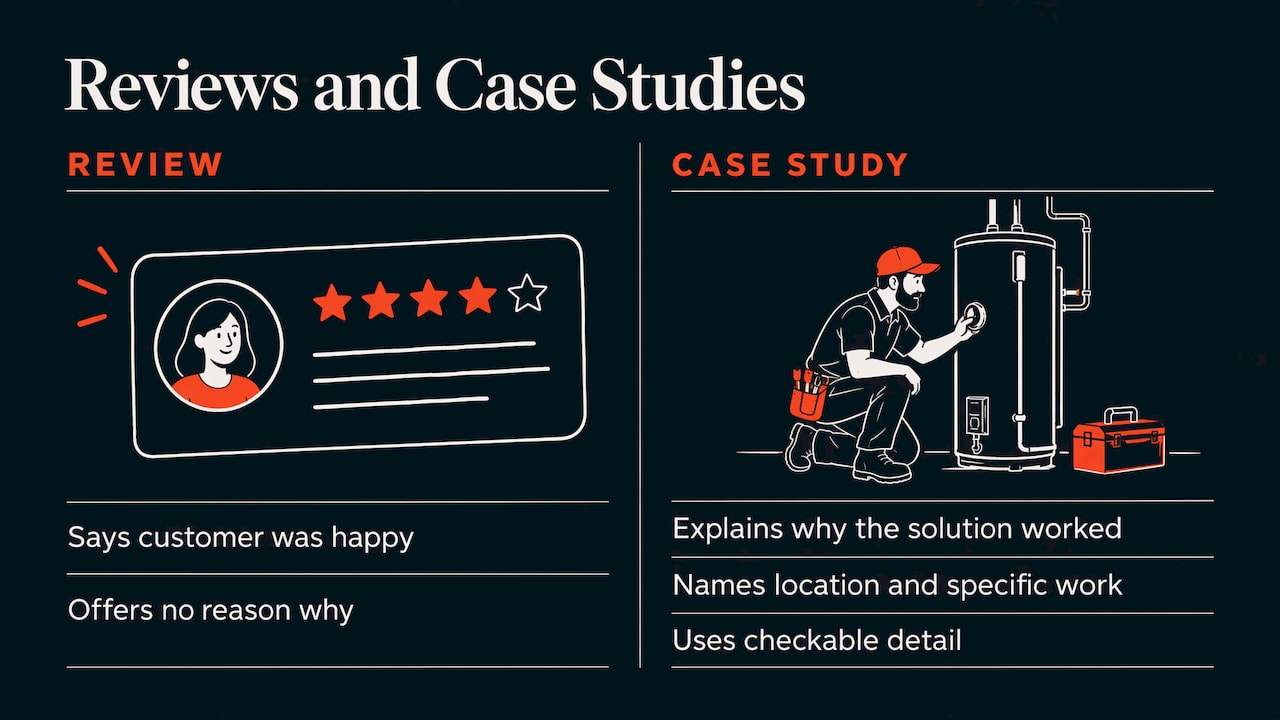
A review says someone was happy. A case study explains why, and it does so in the language your next customer uses when they describe their own problem. That difference matters for local businesses. A homeowner with a failing water heater does not want to know that you are “professional and reliable”. They want to know whether you have handled their exact situation before.
Trade publication Plumbing & Mechanical makes this argument about mini case studies versus reviews: a page about one job names the location and the specific work, helps prospects see themselves in past customers’ problems, and is a strong long-tail search target. Its example is a plumber with a page for a water heater replacement in a specific town. The same logic applies to a Los Angeles roofer, an estate-planning consultant or a three-person marketing agency.
There is a second reason now. AI-powered search tools assemble answers from sentences they can lift cleanly. A paragraph that says “we cut average response time from two days to four hours” is quotable. “We delivered outstanding results” is not. A case study written with checkable detail serves the human reader and the machine reader at once.
The five parts every page needs
Whatever your industry, the page works when it moves through the same sequence. Think of it as five short blocks.
1. The customer and the problem
Say who the customer is in terms a similar customer would recognize: “a two-story home in Silver Lake with a 20-year-old tankless heater” or “a four-person law practice in Pasadena that lost inquiries after hours”. Then describe the problem as they would have said it before they hired you. If the customer will not allow a name, a description of the type of business and the neighborhood does the job. Never invent a customer. A page built on a made-up story damages trust the moment someone asks to speak with that person.
2. What you did
Keep this to the two or three decisions that mattered. Plumbing & Mechanical suggests a local page can include photos of the specific project, a short description of the work, the products and brands used, and a map of the area. For a service business that is a sound checklist. For a consultant, swap photos for a diagram of the process or a screenshot of the finished deliverable. Explain why you chose that approach over the obvious alternative. That reasoning is what shows expertise.
3. The result, with a number
This is the block most pages get wrong. A useful result states a quantity, a timeframe and what held constant. Compare two versions:
- Weak: “Significant improvement in lead flow.”
- Strong: “Booked calls went from 4 a month to 11 over 90 days, at the same ad spend.”
The second can be checked, repeated and quoted. If you do not have a clean number, use a smaller true one: days saved, calls answered, jobs booked from the page. Do not stretch a result to sound bigger. Overstated figures are the fastest way to lose a skeptical reader.
4. A direct customer quote
Place one or two sentences from the customer right next to the result. The quote should say something the numbers cannot, such as how the job felt or what changed in their week. Get permission in writing before you publish it.
5. One line on what it means for the reader
Close with a sentence that connects the story to the visitor: “If your site sends people to a generic contact form, this is the fix we would start with.” Then give one clear next step, such as a link to the matching service page or a phone number.
Tell it as a story, but keep it checkable
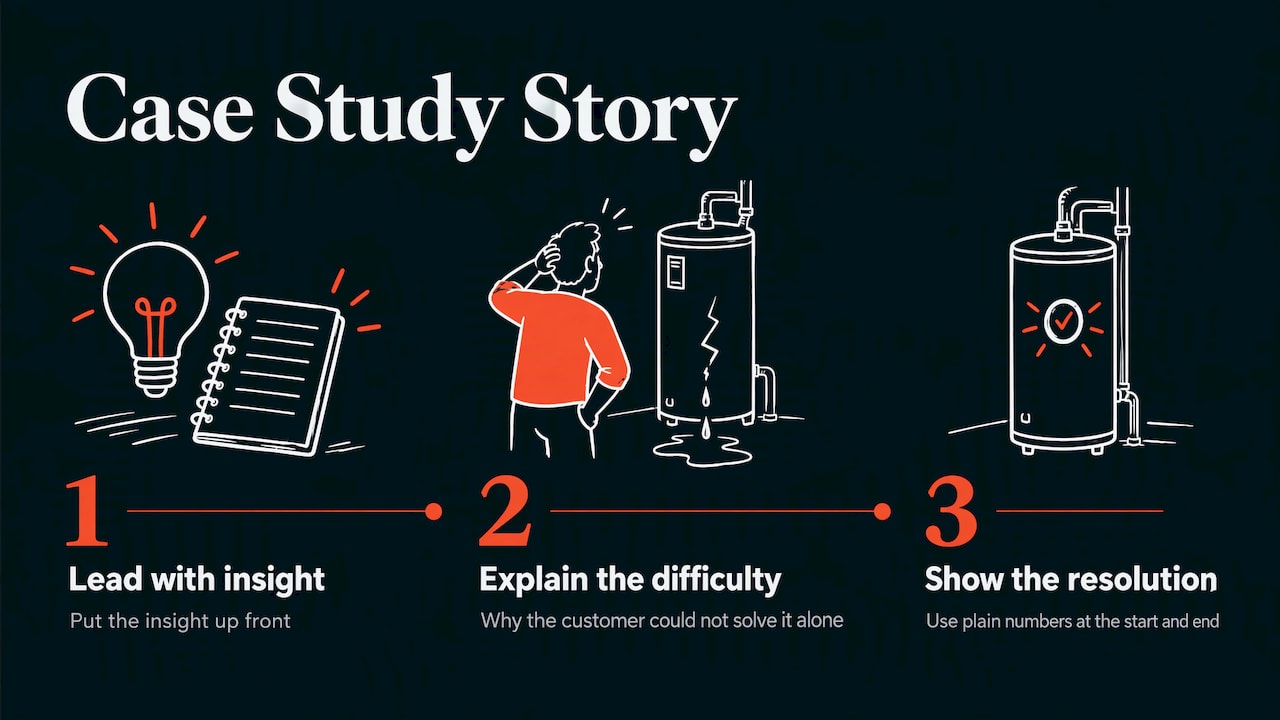
Chris Lonergan of Plumbing & Mechanical argues in that same article that a case study should read like a story, not a clinical record of tasks: the insight up front, the reason the customer could not solve it alone, and a resolution. We agree with the shape. A homeowner who sees why a problem was hard is more likely to call a professional than try a patch.
The discipline is to keep the story honest and the facts firm. Use narrative for the middle, where you explain the difficulty and your decision. Use plain numbers for the start and end. If you are weighing whether to add video to the story, this guide on structuring case study video ads covers narrative flow and proof of results.
Structure the page so it reads in one screen
Most visitors will not read the whole page. They will glance at the top and scroll. Build for that.
- Headline that states the outcome. “Missed after-hours calls cut from 14 to 3 a week” tells the story before the first paragraph. “Client Success Story: Smith Plumbing” tells nobody anything.
- A summary strip. Three short lines near the top: the customer type and location, the service, and the headline number.
- Short sections with plain subheadings. Problem, what we did, result. Each should be a few sentences, not a block of text.
- Visual proof where it matters. A before image in the problem section, the finished work in the result section.
- A single next step. One button or one phone number, placed after the result.
On mobile, which is where most local searches happen, keep the summary strip and the number visible without scrolling far. A page that makes a visitor hunt for the result loses them.
Before-and-after redesign case studies
Website redesign stories are a special case, because the “before” is something visitors can see. That is an advantage, and also a temptation to flatter yourself. Here is how to show the change clearly and fairly.
Show the two states side by side
Use matching screenshots of the same page, at the same width, on the same device. A homepage before and a homepage after is the obvious pair. For a service business, add the page where the enquiry happens: the contact form or the call button. Visitors want to see how the path to getting in touch changed, not only how the design looks.
Name the baseline and the period
A before-and-after number is only meaningful if both sides cover comparable time. Write the baseline plainly, for example “inbound calls in the month before launch” against “inbound calls in the same month the following year”. Comparing a slow month with a busy one can mislead, especially for seasonal work like roofing or landscaping.
A marketing teardown of a hardscaping company’s redesign shows the idea. Marketing Speak’s local services website teardown reports that the client tripled inbound calls after the redesign and the rollout of location pages, measured against a baseline of 2,349 calls in May. The useful part is the stated baseline: a reader knows what “tripled” is measured against.
Say what else changed
If you launched a redesign the same month the customer raised prices or started a promotion, say so. Fair attribution builds credibility. It is fine to claim your work contributed to a result when other factors were involved, as long as you describe them.
Measure quality, not just volume
The same teardown makes a point worth repeating: for a business that charges tens of thousands of dollars, weak positioning on the site brings in leads who get scared by the price, while strong positioning makes buyers expect it. So a good redesign case study reports whether leads got better, not only whether there were more. Useful measures include the share of enquiries that were real jobs, the average job size, and the number of calls that ended in a booking. If you track calls by source, you can report these cleanly. Our guide to call tracking for local SEO covers what to measure.
Make the page findable in Los Angeles
A case study that nobody finds proves nothing. Three habits help.
Name the place and the job in the title and first paragraph. “Tankless water heater replacement in Echo Park” matches how people search. Plumbing & Mechanical calls this kind of page an excellent long-tail target precisely because it carries a location and a specific piece of work. The Marketing Speak teardown makes the same point about city-specific service pages: pages for a particular town and service rank for combinations a general page cannot.
Link it into your site. Each case study should point to the service page it illustrates, and that page should point back. If you work across several neighborhoods, connect the case study to the relevant area page. Our walkthroughs on service area pages and local landing pages show how to build those so each earns its place.
Write sentences that stand alone. AI search tools lift single sentences. Make sure the result sentence includes who, what, how much and when, so it still makes sense when quoted out of context.
If you are also deciding how much to rely on paid ads versus organic visibility, we compare the two in local SEO vs. Google Ads for service businesses.
Choosing credible proof
Not every result belongs on the page. Before you publish, test each claim:
- Can you point to the source of the number (call logs, invoices, analytics)?
- Does the timeframe match on both sides of the comparison?
- Did the customer approve the wording and the use of their name or photo?
- Would the sentence still be true if the customer read it aloud?
This is also how visitors judge agencies and contractors when they read your page. A guide to reading agency case studies walks through spotting verifiable performance evidence, and the habits it describes are the ones your own page should satisfy.
A worked example
Here is a short case study in the shape described above, written for a fictional roofing company so you can see the format. It is an illustration, not a real customer.
Leak repair backlog cut from three weeks to five days in Highland Park
The customer: a 1950s bungalow owner with a recurring ceiling stain. The problem: two earlier patch jobs failed because the flashing around the chimney was the real source. What we did: replaced the flashing and resealed the surrounding shingles, rather than patching the visible stain. The result: no leak through the following rainy season, and the job was booked within five days of the first call. In their words: a short, approved quote about the relief of not thinking about the roof. What it means for you: if a patch keeps failing, ask where the water is entering, not where it shows.
Notice what makes it work: one place, one specific job, a reason the earlier fix failed, a time-bound outcome and a closing line aimed at the next reader. For ideas on what turns visitors into callers on a trade site, see our post on website design for roofers.
How many pages do you need?
Start with three to five case studies, one for each of your main services. Choose jobs where you have a clean number and a willing customer. Update them when you have a better example, rather than piling up thin pages. If you serve several industries, group them logically; our industry pages show how we organize SEO, AEO and website design by sector.
Where we come in
Writing the case study is the easy part. The hard part is a website that puts it where visitors and AI tools will find it, with a clear route to an enquiry. We start with an AI visibility audit, which looks at your site’s structure and content to pinpoint what keeps customers from finding you in AI-powered search, and gives practical recommendations with clear next steps. If the site itself needs rebuilding, our website redesign packages are built around clearer service explanation and better enquiry flows: Website Refresh is $1,000 one-off, Growth Site starts at $2,500 one-off, and Monthly Partner starts at $500 per month.

If calls are slipping through after hours, our AI receptionist founding pilot is $399 per month plus a $500 one-off setup fee, with additional minutes at $0.50 per minute. You work directly with the studio founder, and each engagement is scoped to your business.
Our perspective
Most small service businesses already have the raw material for a good case study. They just never wrote it down in a form a stranger could trust.
We look at websites through the eyes of both a worried customer and an AI answer engine. Both want the same thing: a specific claim they can check. When a page says what the problem was, what was done and what changed, with a number and a timeframe, it clarifies your services and makes it easier for people to reach out.
That is why we pair audits with practical recommendations rather than generic reports. A case study page is one of the clearest foundations you can lay, and it works hardest when the rest of the site, from service pages to the enquiry path, points to it. Start with one real job, tell it plainly, and build from there.
Ash
FAQ
How long should a service case study page be?
Long enough to cover the five parts and short enough to read in a couple of minutes. For most local service jobs, 300 to 600 words plus a few images is plenty. Put the result near the top so a skimmer still gets the point.
What if I do not have a hard number to show?
Use a smaller true one: days to complete the job, calls answered, bookings from a specific page, hours saved per week. A modest, checkable figure is more persuasive than a vague claim. If the customer cannot share figures, describe the change in concrete terms and add their quote.
Should I name the customer?
Only with their written permission. If they prefer privacy, describe the type of business or home and the neighborhood. Do not fabricate a customer or a quote.
How is a case study different from a testimonial or review?
A review states an opinion. A case study explains the situation, your method and the measured outcome, so a similar prospect can recognize their own problem. Include a quote in the case study, but let the story and the numbers carry it.
Do I need a separate page for each neighborhood?
Not necessarily. Create a page when you have a real job to describe in that area. Name the neighborhood and service in the title, and link it to your relevant service page. Our guide to multi-location SEO explains how to scale this without thin pages.
Sources
- Why mini case studies are better than reviews, Plumbing & Mechanical
- Local Services Website Teardown: A Case Study with Greg Merrilees, Marketing Speak
- Case Study Video Ads: Structure, Examples and Proof
- Agency Case Studies: How to Read Them and Choose Well